28th August 2006

al-Hazred

Down & Out in Heaven and Hell


28th August 2006
David R Williams

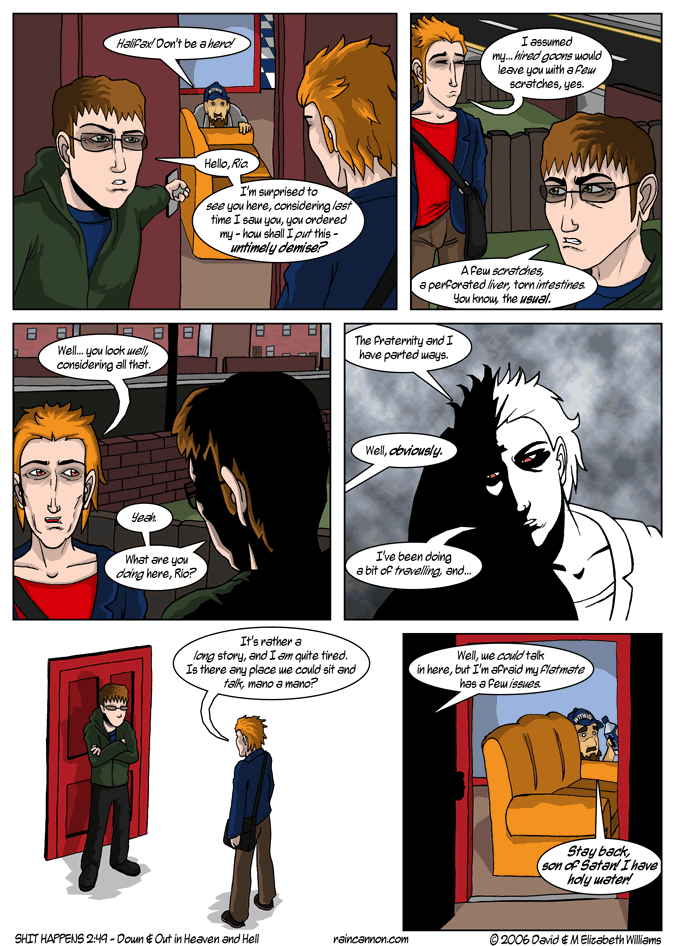
Recently, I've been using a reference guide to help me compose some of these strips a little better, namely Wally Wood's 22 Panels That Always Work.'
The reason for this is that whenever I get a new script off Mary, the temptation is to draw the draft version and then not deviate from that at all. This is all well and good, but for the most part the draft copy tends to be an attempt to get down onto the page the panel placement and who has to be in each panel. It's often something of a chore to then go back over this and re-think each individual panel for framing, composition, etc, which is why when you have talking heads strips -- and the webcomic medium, if such a thing can be said to exist, is overwhelmingly dominated by the talking heads strip -- it's often a lot easier to just thrash out a few panels of people standing at three-quarter angles against a flat, level background that looks as if it's been ripped off a blueprint. (Drawing a background from a flat non-perspective is a lot easier on a computer than drawing a background with a definite eyeline and vanishing points, which is part of the reason I started drawing most of my backgrounds on the paper originals.) What Wally Wood did, back in the '70s, was compile a set of panel compositions that could be used to convey the story effecitvely, but in a visually interesting way.
The 22 Panels serve not only as a great timesaver (yes, I suppose you could argue that copying a couple of panels here and there from a list someone else has made is a bit unoriginal, but no more unoriginal than uninspired three-quarter shots of people talking against flat backgrounds) but also as a useful jump-off point for coming to your own conclusions about panel composition. Using the guide has made me look at the idea of leaving panels open, and going with a minimalist or else completely absent background, for effect.
The good thing about the twenty-two panel guide is that it doesn't put meaning or context on these panels, just the technical aspects of them, which means you're free to work out what kind of effect each one conveys. I like this kind of resource, especially for purposes of Shit Happens, which we've long-stated is an experiment: Mary gets to work out how comic scriptwriting works, as well as long-form serials and intertwining plot threads, while I get to figure out what makes comics tick by trying everything and deciding what does and doesn't work.

Bottom line: everyone interested in making comics, whether new to the game or old hand, should be taking a look at Wally Wood's 22 Panels That Always Work, even if just to decide that they have nothing to offer them.


DAVID'S DVD EASTER EGGS:

Shakra doesn't know that just drawing a cross on a bottle of Fiji Water doesn't make it holy water.


All writing David R. Williams and M. Elizabeth Coy 2003-2005 unless otherwise noted. All artwork by David R. Williams. Site design by M. Elizabeth Coy.
This comic is listed on OnlineComics.net