--author image-->
|
Holy Terror
25th August 2006
David R Williams
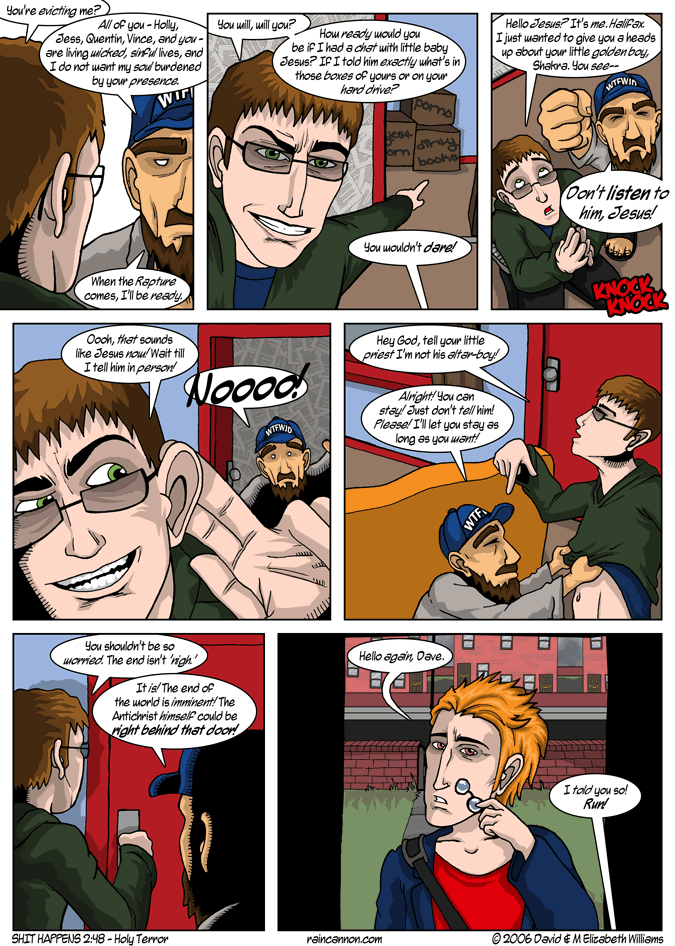
I think this is my favourite script that Mary's written all year. You can tell I liked it because I went all fancy with the 'camera' angles and stuff. When I really like a script I always want to make it look good, whereas if I'm indifferent about a script I'm more content to let the art be a bit more pedestrian. This is probably a good lesson for all writers: entertain your artists and they will provide better artwork. Also it probably explains why my artwork last year was really bad in some bits, because I was trying to write too much into each script and half the time ended up cluttering things up so much that the art and text were fighting for space on the page.
For this one, I tried managing the panel layout by working which beats of the story were the most 'important' and assigning more size to a panel based on how important it was in terms of the story being conveyed. While it worked in a sequential art sense I ended up with a cluttered panel or two where a panel I'd deemed as more 'unimportant' ended up having much more dialogue than an 'important' panel. Amount of dialogue really isn't a measure of how important a panel is, but in this case I've learned that you should always make sure you at least clear enough space for the dialogue to comfortably fit.
I played a bit with close-ups in this strip as well. Close-ups are a nice way of creating depth in a panel, not to mention that a facial close-up is much more expressive in many cases than a full-body shot.
The more I work on drawing comics, the more I think about the positioning of a theoretical 'camera' and try to 'shoot' the scene in a visually interesting way. Dynamic positioning can help set up a scene really well: imagine if the third panel of today's comic (with Halifax praying on his knees and Shakra standing and waving his fist) was drawn as a three-quarter angle from eye level. Which isn't to say that placing the theoretical camera at eye level doesn't have its uses: it forces the reader to imagine themselves in the place of a personal spectator and draws them into the narrative much more readily. Many popular 'slice of life' webcomics tend to work this way, possibly because the creator realises the value of making the reader feel a part of the comic, or possibly because they're largely talking heads comics where character movement isn't as important, much like a television sitcom. I'll venture forth a shaky theory here that many creators who draw comics almost exclusively as eye-level, mid-shot comics are ones making comics based around their own lives and circles of friends, where it's easier for them to imagine being a part of the scene. I'm not immune to this, lest anyone think I'm looking down my nose at them: in scripts where Mary has a conversation going on between people and the flow of dialogue is important, I try to stick to simpler eye-level style shots, because in those cases the use of more dynamic positioning would probably just prove a distraction to the actual story being told.
DAVID'S DVD EASTER EGGS:
The final shot is a reversal of the last time Halifax and Rio met, when Rio opened the door to Halifax as he returned from Milton Hoight. But of course, you all knew that, true believers!
--rant-->
|
|
--second rant-->